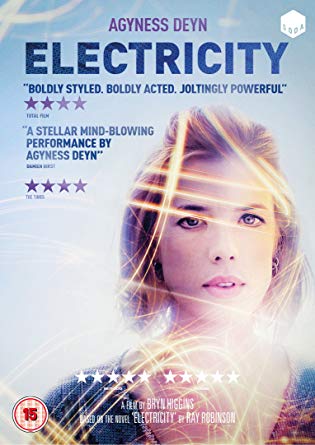

Bryn Higgins (Director)
Sukey Fisher (Screenwriter)
Stone City Films (Studio)
2014
96 minutes running time
According to the Art:
This movie was created to render the seizure experience of people with epilepsy; the storyline is secondary to this aim. It also shows how filmmaking can be effective in capturing the seizure experience in ways that other art forms cannot.
Synopsis:
Lily O’Connor is thirty–something and she is working at a seaside arcade in northeastern England. She inherits some money from her mother’s small estate and wants to give her brother Michael his share. But, Lily lost track of Michael during their childhood after they were placed in separate new homes to protect them from the severe abuse their mother was inflicting on them. Michael has become a ne’er-do-well in adulthood, and so Lily’s search for him takes her through the dark alleys of London and puts her in the company of its dodgier inhabitants.
A bigger challenge to Lily in her search and in her life more generally is epilepsy. How she experiences epilepsy forms the more interesting and dramatic elements of the story. We witness Lily have several seizures in a variety of scenarios: before a date, on the subway, at a friend’s house, in a hotel room, and in a nightclub. We see how Lily senses them coming on as she says to herself:
Here’s the breath,
here’s the breeze,
here’s the shimmer…and I’m falling down the rabbit hole.
We see the ground in front of her becoming fuzzy but closer, then what looks to be her hand reaching out in front of her to lay a sweater down on the ground where she thinks she will land, and then the ground getting fuzzier still as she hits it. From the ground, we see that she can still make out some people bending down to help and others averting their gazes. As Lily loses all focus, hallucinations start, and we see her body floating among patterns of electrical bursts as she experiences them. Next we hear her scream before all goes dark and violent shaking starts. As she regains consciousness, we see what she sees, blurry at first and then as her surroundings come into focus. It may be the inside of an ambulance, a hospital room, or her apartment, where in anticipation of that possibility, she has painted on her walls:
Don’t Worry Lily Home Bed Sleep SAFE NOW
As Lily goes into recovery after a seizure, the director takes us from Lily’s point of view to the point of view of bystanders. We see that as a result of these seizures, Lily often sustains bone fractures, lacerations, abrasions, puncture wounds, and bruises among other injuries. She goes about cleaning herself up in a manner that suggests a routine, something she expects. Nevertheless, the loss of time frustrates her.
I just lost 2 days. Chop it up. Chop it out of my life. All the outtakes. What would they look like if you put them all together.
Lily’s adaptation to her seizures and their consequences vexes the physicians she consults, which she does only when her medications are stolen and she needs new prescriptions, and when she is taken to the hospital after particularly bad seizures. These physicians want to get Lily onto newer and presumably better medications. She resists, saying to one of them,
All I want is my old meds back. You know when my scripts change, it messes with my head every time. If you wanna know why I’ve stayed on the old meds, it’s ‘cause I know who I am…You have no idea how new drugs change me, they make me feel like a ghost. Words fall out of my mouth like vomit. My brain, a lump of cold meat. Nah, I’m not doing it.
She decides to forgo all medications if she must move to a new regimen, but it doesn’t go well. Eventually she capitulates, adapts to new medications, and goes on with her life, or as she says, “Thrash, get up, get on with it.”
Analysis:
The emphasis on epilepsy in this story is intentional. The Wellcome Trust co-funded the movie with the British Film Institute because it saw in Lily’s story an opportunity to explore temporal lobe epilepsy “through her eyes.” The film is based on the novel Electricity, written by Ray Robinson and published in 2006. Robinson told the Epilepsy Society (UK),
My first experiences of epilepsy were as a child. I witnessed my cousin’s seizures every day—she lived with us—both her terrifying hallucinations and her full blown tonic-clonics. This had a profound impact on me. It was terrifying but, perhaps perversely, intriguing. Watching her thrashing about on the floor, I’d wonder what it felt to be her, and those early experiences are something that I’ve always tried to write about.
As an author, Robinson tells us what the seizure experience can be like. As a filmmaker, Higgins shows us what the seizure experience can be like. Higgins, in interviews in Directors Notes and in the Welcome Trust blog, makes a further point that the nature of filmmaking is particularly well suited to seizure experiences.
With its jump cuts and out takes and capacity for visual distortion—[film] is ideal for representing the inner and outer experience of living with epilepsy. The whole slightly fragmentary, chaotic nature of the film and its structure is based on the ambition to convey what it is like to walk through the world as Lily.
Higgins goes further to suggest that film is the best way to render the seizure experience. Maybe for some, but besides Robinson’s novel that serves as the basis of this movie, Paul Harding’s Tinkers and Fyodor Dostoevski’s The Idiot are novels that offer vivid depictions of seizure episodes and their impacts on quality of life for those who suffer them. (Literary depictions from these two novels as they compare to contemporary biomedical text are shown in a separate post here.) David B’s Epileptic presents the experience in the graphic memoir form. A combination of these genres and others yet can work together to form a fuller view of seizure experiences than any of them alone.
Also:
The Welcome Trust involvement in this movie stems from its belief “in the power of ideas to improve health. We support thousands of scientists and researchers in more than 70 countries, as well as innovators, educators and artists.”
This review has also been posted to the NYU Literature, Arts and Medicine Database.