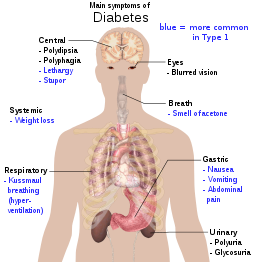

Type 2 diabetes (T2D) usually occurs in adults, and they often notice its onset from characteristic signs and symptoms. Here is a poem by James Dickey describing his experience with the onset of T2D and some accommodations he makes to his doctor’s recommendations for managing his condition compared with classic biomedical texts.
The Biomedical
From Type 2 diabetes presentation and diagnosis as described in Annals of Internal Medicine, In the Clinic, March 3, 2015:
Clinicians should confirm the diagnosis of diabetes in persons with classic symptoms (polyuria, polydipsia, polyphagia, and weight loss) or in those with evidence of diabetes complications (retinopathy, nephropathy, neuropathy, impotence, acanthosis nigricans, or frequent infections). There are many tests that can be used to diagnose type 2 diabetes…Alternatively, diabetes can be diagnosed in persons with classic symptoms and a nonfasting glucose ≥200 mg/dL, again confirmed by a second test.
From Dietary and nutritional approaches for prevention and management of type 2 diabetes in BMJ 2018; 361: k2234 doi: 10.1136/bmj.k2234 (Published 13 June 2018)
The idea of being on a ‘diet’ for a chronic lifelong condition like diabetes is enough to put many people off as knowing what to eat and maintaining an optimal eating pattern are challenging…Most physicians are not trained in nutrition interventions and this is a barrier to counselling patients.
The Poetic
From Diabetes: I, Sugar by James Dickey. In: On Doctoring, R. Reynolds & J Stone, editors. New York; Simon & Schuster, 1991: pp. 199-200.
Diabetes
I
Sugar
One night I thirsted like a prince
Then like a king
Then like an empire   like a world
On fire. I rose and flowed away and fell
Once more to sleep. In an hour I was back
In the Kingdom   staggering, my belly going round with self-
Made night-water, wondering what
The hell. Months of having a tongue
Of flame convinced me: I had better not go
On this way. The doctor was young

And nice. He said, I must tell you,
My friend, that it is needles moderation
And exercise. You don't want to look forward
To gangrene and kidney

Failure   boils blindness infection skin trouble falling
Teeth coma and death.
O.K.
                        In sleep my mouth went dry
With my answer    and in it burned the sands

Of time with new fury. Sleep could give me no water
But my own. Gangrene in white
Was in my wife's hand at breakfast
Heaped like a mountain. Moderation, moderation
My friend, and exercise. Each time the barbell
Rose   each time a foot fell
Jogging, it counted itself
One death   two death   three death and resurrection
For a little while. Not bad! I always knew it would have to be
                                               somewhere around
The house: the real
Symbol of Time I could eat
And live with, coming true when I opened my mouth.
True in the coffee and the child's birthday
Cake   helping sickness be fire-
Tongued   but not bad, sweet sand
Of time, my friend, an everyday—
A livable death at last.
Comments
The poem covers the trajectory of type 2 diabetes. The trajectory is partitioned into four phases: 1) onset of symptoms; 2) seeking medical attention and recommended treatment regimens; 3) attempts to comply with treatment regimens; and 4) seeking and finding an acceptable balance between management requirements and some joy (i.e., “a livable death”)
The poem attaches personal and emotional reactions to these phases. The symptoms are surprising, disruptive, frustrating, and worrying. Potential consequences of diabetes are surprising, dramatic and frightening. The treatment regimens are motivating and oppressive. Finding the acceptable balance between strict compliance and joy comes with realizing it’s a matter of eating the time remaining to live.
This poem was featured in an episode of the podcast, The Clinic & The Person, I cohost with Dan Albrant and with executive producer Anne Bentley