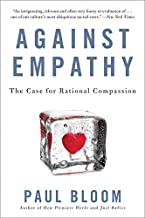

Paul Bloom
New York
Ecco
2018
241 pages
According to the Art:
The book does a service in challenging empathy as an unmitigated force for good. Those who are interested in a fuller and balanced exploration will benefit from a more comprehensive and scholarly effort.
Synopsis:
This blog mostly concerns works from the Humanities that in some way add to or elaborate on biomedical concepts related to particular clinical events and health care situations. On that basis, the blog content falls under the “medical humanities” field of study (some say, “health humanities). The field gives a considerable amount of attention to “empathy,” and in particular, as it can make health care providers, mostly physicians, more empathetic. A book called, Against Empathy, would naturally be greeted with horror, or at least viewed with deep skepticism and suspicion, by many in the field, if not rejected prima facia. The argument needs to be taken into account, regardless.
The author, Paul Bloom, is a professor of psychology at Yale University. He says, “I am against empathy, and one of the goals of this book is to persuade you to be against empathy too.” (p. 3) He gets more specific when he says, “I want to make a case for the value of conscious, deliberative reasoning in everyday life, arguing that we should strive to use our heads rather than our hearts.” (p. 5)
Bloom works from empathy considered as “the act of coming to experience the world as you think someone else does.” (p.17) He separates “emotional empathy,” feeling what someone else feels, from “cognitive empathy,” understanding what someone else feels without feeling it. Bloom’s objection is with emotional empathy; it does more harm than good in his view. His counter is putting an emphasis on “rational compassion” instead. In Bloom’s formulation, compassion still involves “feelings of warmth, concern and care for the other, as well as a strong motivation to improve the other’s well-being,” and by reducing or eliminating the emotional component of empathy, room is made for reasoning. (p. 138) Better ends will come as a result.
Bloom returns often to how empathy isolates problems in ways obscuring other important considerations. He uses the metaphor of a spotlight in making this point, because spotlights have a narrow focus and capture (steal?) attention. Empathy generated from this narrow focus on a particular problem and the attention drawn to it can divert attention and resources of greater importance to many more, and in this way can take the form of injustice. As examples he points to the empathy behind all the attention a baby trapped in a well receives while thousands are victims of genocide in faraway places, and how “each day more than ten times the number of people who died in Hurricane Katrina die because of preventable diseases.” (p. 91) Violence that can result between individuals when empathy for one who is wronged generates a revenge response in another, and the same can occur writ large when individual countries are involved. A more relatable example Bloom offers is the burnout that continued, intense empathy can cause health care professions concerned about colleagues to the degree patients are provided less care than they would receive otherwise. He offers many more examples along these lines.
Attempting to strengthen his argument, Bloom reports research findings from various imaging studies and psychological experiments confirming his worries about empathy. He also cites the moral philosophy of Adam Smith, David Hume, Immanuel Kant, and Aristotle in making his case.
Yet, he wavers in the end. “I don’t deny that empathy can sometimes have good results…it’s that its negatives outweigh its positives—and that there are better alternatives.” (p. 241) And, with that, his argument disappoints when judged against its polemical title.
Commentary:
It’s a startling notion for many, being against empathy, especially for those who travel in medical humanities circles, and among those involved in health professions education and training. Empathy is an animating force behind their missions. Alas, Bloom’s argument does not threaten the central role for empathy in health care, although it could sharpen its use.
The book does a service in challenging empathy as an unmitigated force for good. But Bloom’s approach is breezy, aimed at a broad audience, and derives from a mostly utilitarian perspective. Those who are interested in a fuller and balanced exploration will benefit from a more comprehensive and scholarly effort.
Perhaps it’s not the content of the book that’s the problem, but rather its title. He’s against empathy because, even though he knows of its value at times, on balance it causes more problems. That makes empathy something to manage, not eliminate.