
Edvard Munch
1885
Oil on Canvas
According to the Art:
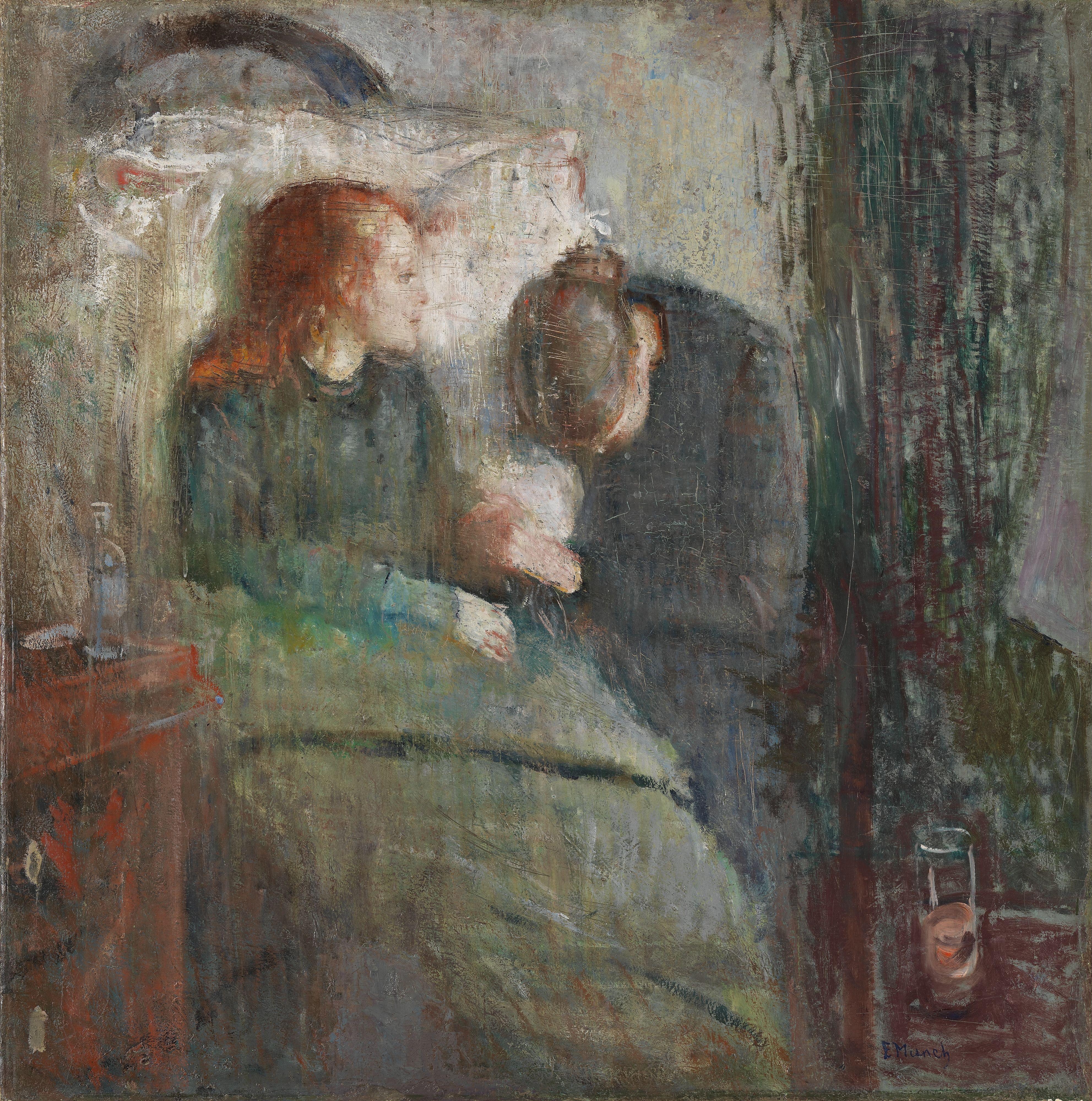
The Norwegian, expressionist painter Edvard Munch saw a lot of illness and death in his family. In this painting, he shows us a moment preceding the death of his sister while she is attended to by a distraught aunt. He may also be showing us his sister consoling their aunt.
Synopsis:
Edvard Munch’s painting, The Sick Child, hanging in the National Museum in Oslo, Norway, is his first version of the painting. This version is done in oil on canvas and was completed in 1885. He went on to paint several versions over the next forty years. He wrote that the first version was “a breakthrough in my art,” which influenced his painting thereafter.
As we come upon this painting, we quickly realize we are standing at the end of a bed intruding upon a poignant moment. In this expressionistic painting, we can discern an adolescent girl propped up in bed. She is facing an older woman sitting at her side. We don’t see this woman’s face because her chin is on her chest in a way that makes her look distraught. We can easily conclude that she is the girl’s mother and that the girl is sick, very sick.
When we look around the room with the view Munch gives us, we see little in the way of medical supplies or equipment. There is only a bottle on a nightstand that might be some potion and a glass of water on a dresser. Nothing more is to be done for this child. She seems to know it and so she tries to comfort the woman who is attending her. The painting reminds the viewer that often those who are dying offer comfort to the ones attending them as well.
Analysis:
The girl in this painting is Edvard Munch’s older sister, Sophie. They were only a year apart. The woman beside her is not the girl’s mother; she is the girl’s aunt. Their mother had died from tuberculosis about ten years before, and now Munch’s sister was to die of the disease at the age of fifteen. He was known to have said, “Few artists ever experienced the full grief of their subject as I did in The Sick Child.”
Munch put a particular focus on poor health and its consequences into his work, as he himself was deeply familiar with both. “Illness, insanity and death were the black angels that hovered over my cradle,” is how he put it according to his biographer Sue Prideaux. Several members of his family, not just his mother and sister, suffered from serious health problems. Many of his paintings that involve health problems show both the people who are sick and the people around them who worry and fear the worst. In rendering illness experiences in his paintings, Munch expands the view beyond the person suffering from illness to those who suffer with them, and how they can help each other.
Also:
More detail about The Sick Child is available from an interview with noted Munch expert and curator, Øystein Ustvedt in an episode of the podcast, The Person & The Clinic.
I write more about how Munch’s experience with illness and death affected his art here.
A version of this review is posted here on the NYU Literature, Arts and Medicine Database.
Image source: National Museum, Oslo, Norway
Image photograph credit: Børre Høstland
Image released under Creative Commons Attribution Lisence (CC-BY)