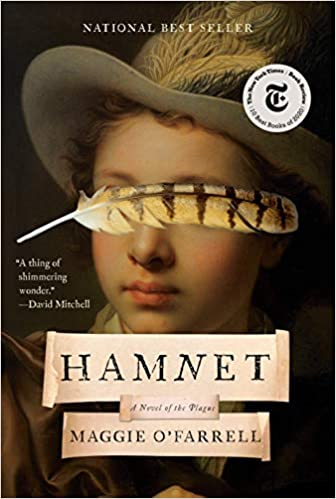

Maggie O’Farrell
Alfred A. Knopf
New York
2021
305 pages
According to the Art:
The novel centers on the eleven-year-old son of a late sixteenth-century playwright and stage performer who died from the plague in Stratford, England. Story elements touching on medical humanities concerns include death, grief, dread, childbirth, and how plague infections spread.
Synopsis:
“He is dead, he is dead, he is dead,” Hamnet’s mother says of her son. (p. 219) He could not evade the bubonic plague pulsating through England during the late sixteenth and early seventieth centuries. Hamnet had only reached eleven years of life in 1596 when it was taken. The novel covers Hamnet’s family in a fractured narrative form from the time it was taking shape until about four years after his death.
Hamnet’s family lived in Stratford, Warwickshire, England, which is a small town located about a two-day horseback ride from London. Hamnet, his twin sister Judith, and their older sister Susanna were born in the house they would live in as they grew up. Their paternal grandparents lived in an attached dwelling, and Hamnet’s grandfather made gloves for a living in an adjacent workshop. Hamnet’s mother, Agnes Hathaway, compounded and sold herbal remedies, and helped out with family livestock. The story tells of her early life in the country and her expedited courtship with her husband, who O’Farrell never names. Not long after their marriage, Agnes’s husband left for London where he became a successful playwright and stage performer, which left him few opportunities for returns to Stratford. He was able, nevertheless, to support his family and eventually move them into more spacious and comfortable quarters.
Thus is the setting for story’s central concern: Hamnet’s death and the grief that followed.
Grief undoes Agnes. Before, she was “someone who felt sure of life and what it would hold for her; she had her children, she had her husband, she had her home…Her feet moved over the earth with confidence and grace.” (p. 251) Not after Hamnet dies, though.
This person is now lost to her forever. She is someone adrift in her life, who doesn’t recognize it. She is unmoored, at a loss. She is someone who weeps if she cannot find a shoe or overboils the soup or trips over a pot. Small things undo her. Nothing is certain any more.
p. 251
Amplifying the grief Agnes suffers is her husband’s return to London soon after the burial because he feared his theater work would lose irretrievable ground with a prolonged absence. Her grief morphs into anger and incredulousness when she learns, four years hence, that her husband has written a play called Hamlet (a name considered interchangeable with “Hamnet” then). How could he do this if he was grieving a beloved son, she wonders. He is exploiting their dead son, she thinks. He has forgotten he had a son, she fears. “He is himself, not a play, not a piece of paper, not something to be spoken of or performed or displayed. He died. Her husband knows this…She cannot understand.” (p. 287)
Agnes heads to London. She will confront her husband, but not before she attends the play. While watching it, however, she sees how he has indeed been suffering through his role as the ghost of Hamlet’s dead father.
Her husband has brought him back to life, in the only way he can. As the ghost talks, she sees that her husband, in writing this, in taking the role of the ghost, has changed places with his son. He has taken his son’s death and made it his own; he has put himself in death’s clutches, resurrecting the boy in his place…He has, Agnes sees, done what any father would wish to do, to exchange his child’s suffering for his own, to take his place, to offer himself up in his child’s stead so that the boy might live.
p. 304
Hamnet’s father has grieved, suffered, and remembered his son.
Analysis:
Maggie O’Farrell shows guts writing this novel. The pressure is on any author who sets a novel in a time when a few select writers, and one in particular, were defining the “human” or at least revealing “human character.” O’Farrell might be expected in some literary circles to show similar insights into human nature, and to express them in beautiful poetry and prose. She tries to meet these expectations, wittingly or unwittingly. I’ll leave to literary scholars whether or not she succeeds on that count. Her fractured narrative yields a cleverness and intensity to the novel, as do the figures of repetition she uses (e.g., anaphora, disjunctio), that nevertheless make for a much more interesting story than what could have been bland descriptions of a quotidian and hardscrabble life in the sixteenth-century English countryside.
O’Farrell offers many insights that will interest people drawn to medical humanities. She calls the book, “a novel of the plague,” and thus considers how the bubonic plague ravaging Europe and England, killing millions, could affect an individual family. O’Farrell gives most attention to the dread of losing a child and the grief of having lost a child. Childbirth and how plague infection spreads get less, but significant attention. O’Farrell comes at these insights from not just research and creativity, but personal travails. She has had many harrowing “brushes with death,” as she calls them, that ring similar to some she includes in the novel, and which she describes in her memoir, I Am, I Am, I Am (which I review here).
Agnes and her husband, like other Stratford, England parents were well aware of the bubonic plague. The plague had been visiting Europe and England since mid-fourteenth century. O’Farrell imagines the dread they must of all felt, especially anytime their children showed any signs of any illnesses, such as when Agnes noticed signs of plague on Judith.
What she has always dreaded is here. It has come. The moment she has feared most, the event she has thought about, mulled over, turned this way and that, rehearsed and re-rehearsed in her mind, during the dark of sleepless nights, at moments of idleness, when she is alone. The pestilence has reached her house. It has made its mark around her child’s neck.
pp. 105-106
Dread stalks all parents when it comes to possible harms their children could encounter. The degree of dread likely peaks during pestilence visitations. such as the circumstances O’Farrell describes, and reaches a degree not relatable to most people in “normal times.” The book, published during the 2020 Covid-19 pandemic when the number of people severely ill or dying is widely publicized and creating fear, makes the dread O’Farrell depicts more relatable and real than it might have otherwise.
Judith is not the child who dies. Hamnet is stricken at the same time, but his predicament goes unnoticed right away. He succumbs. O’Farrell depicts Agnes’s searing grief, and atomizes the mental and physical manifestations. In one rendering of the mental effects, Agnes thinks,
This cannot happen, it cannot, how will we live, what will we do, how can Judith bear it, what will I tell people, how can we continue, what should I have done, where is my husband, what will he say, how could I have saved him, why didn’t I save him, why didn’t I realise it was he who was in danger?
p. 229
In a rendering of the physical effects, Agnes discovers,
that it is possible to cry all day and all night. That there are many different ways to cry: the sudden out-pouring of tears, the deep, racking sobs, the soundless and endless leaking of water from the eyes (pp. 241-242)…Tears seem to come not just from her eyes but from every pore of her body.” (p. 227)
Vivid portrayals of child birth in both biomedical and literary forms have existed since written forms have, surely. Can there be any now worth pointing out? O’Farrell’s telling of Agnes giving birth to her twins seems worthy of consideration for both biomedical teaching and literary purposes such as applying figures of repetition.
Nothing, however, could have prepared her for the relentlessness of it. It is like trying to stand in a gale, like trying to swim against the current of a flooded river, like trying to lift a fallen tree. Never has she been more sensible of her weakness, of her inadequacy. She has always felt herself to be a strong person: she can push a cow into milking position, she can douse and stir a load of laundry, she can lift and carry her small siblings, a bale of skins, a bucket of water, and armful of firewood. Her body is one of resilience, of power: she is all muscle beneath smooth skin. But this is something else. Something other. It laughs as her attempts to master it, to subdue it, to rise above it. It will, Agnes fears, overtake her; It will seize her by the scruff of her neck and plunge her down, under the surface of the water.
pp. 131-132
O’Farrell also offers biomedical lessons through her detailed account of how Judith and Hamnet get infected. She starts at the beginning of the infectious cycle.
For the pestilence to reach Warwickshire, England, in the summer of 1596, two events need to occur in the lives of two separate people, and then these people need to meet. The first is a glassmaker on the island of Murano in the principality of Venice; the second is a cabin boy on a merchant ship sailing for Alexandria on an unseasonably warm morning with an easterly wind.
p. 140
The glassmaker used several rags in packing an order for millefiori beads heading by boat to London and then over land to Stratford, England. The cabin boy was on shore in Alexandria when an infected flea from a monkey jumped on him and came aboard the ship carting the millefiori beads. O’Farrell traces how the fleas sustained themselves during the journey by jumping from people to cats to rats and back to people, infecting their hosts as the moved from one to another. Eventually, fleas fell into the box containing the millefiori beads and they nestled in the rags. Some of them escaped and found their way onto the rider taking the box to Stratford, and by the time he reached his destination, “the fleas have laid eggs: in the seams of his doublet, in the mane of the horse, in the stitching of the saddle, in the filigree and weave of the lace, in the rags surrounding the beads. These eggs are the great-grandchildren of the monkey flea.” (p. 150) Reader, the rider died.
A delivery boy—Hamnet, presumably—picks up the package at an inn where the rider left it and takes it to the seamstress who ordered the beads, and in doing so, presumably picks up some of the infectious fleas. At the seamstress shop, a girl working there sees the long-awaited package with the millefiori beads.
The seamstress holds aloft the box. ‘Look,’ she says to the girl, who is small for her age, and fair as an angel, with a nature to match.
p. 151
The girl clasps her hands together. ‘The beads from Venice? Are they here?’
The seamstress laughs. ‘I believe so.’
‘Can I look? Can I see? I cannot wait.’
The seamstress puts the box on her counter. ‘You may do more than that. You may be the one to open them. You’ll need to cut away all these nasty old rags. Take up the scissors there.’
She hands the girl the box of millefiori beads and Judith takes it, her hands eager and quick, her face lit with a smile.
Judith is the girl. The infectious cycle is complete. Judith nearly dies. Hamnet does. O’Farrell’s fictional account of the bubonic plague infectious cycle is a worthy companion to biomedical explanations.
Also:
A comparison of a biomedical description of how the plague spreads with O’Farrell’s literary description is here.
Winner of the 2020 Women’s Prize for Fiction